On this page:
- How many hours each week a student employee may work (in all jobs combined)
- Calculate Work-Study Student Hours & Other Wage Considerations
- Student Web Time Entry of Hours, Payroll Schedule, Direct Deposit, Pay Stubs
- Break and Meal Times
- Safety
- Military Service
- Jury Duty
- Drug and Alcohol Policy
- Supervisor Tips for Success
- Student Employee Tips for Success
- Student Employee Evaluations + Form
- Separation, Termination & Grievance Procedures
Questions? Email studentemployment@wright.edu
Limits on Maximum Working Hours per Week (in All Jobs Combined)
Calculate Work-Study Student Hours & Other Wage Considerations
Student Web Time Entry of Hours, Payroll Schedule, Direct Deposit, Pay Stubs
Break and Meal Times
A student scheduled to work a four-hour to six-hour shift should get a 15-minute paid break per shift.
A student scheduled to work more than six continuous hours but less than seven continuous hours is entitled to one 15-minutes paid break and a 30-minute unpaid meal break.
A student scheduled to work over seven continuous hours is entitled to two 15-minute paid breaks and a 30-minute unpaid meal break.
Breaks are scheduled by the supervisor to maintain efficiency of the work unit. Breaks must be preceded and followed by work and should not be used to cover a student's late arrival or early departure. Time designated for rest periods cannot be accumulated. In some instances, by agreement, supervisors may permit student employees to combine their paid breaks with their unpaid lunch periods. This practice is acceptable as long as it does not interfere with efficiency or result in fatigue for individuals whose work is excessively strenuous, dirty, dusty, hot, or cold. When these conditions exist, a break is essential.
When using Web time entry, students are required to enter a work beginning time and a work ending time (time in and time out). A student taking a paid break should not 'time out.' Students must 'time out' for any unpaid breaks in their work schedule.
Safety
The employing department is responsible for providing student employees with the safety training necessary to ensure that the employee is able to perform the job in a safe manner. Supervisors and student employees are responsible for referring to the University Policy and the website for the Department of Environmental Health and Safety, to become familiar with safety policies. All required personal protective equipment must be provided to the student employee by the employer.
- University Policy 13301.3: Environmental Health and Safety: Responsibilities
- Environmental Health and Safety: Training Questionnaire
- Environmental Health and Safety: Training Courses and Instructions
- University Policy 13275: Reporting Injuries and Illnesses
Military Service
Student employees who are members of the Ohio National Guard, or any other reserve component of the United States Armed Forces, or who are involuntarily ordered to extended U.S. military service shall be granted leave without pay. The student employee is required to submit to their supervisor a copy of military orders or another statement in writing from the appropriate military authority in evidence of the call for training or duty. The student employee shall be returned to their former position upon re-registration as a student.
Jury Duty
A student employee may be summoned for jury duty or to serve as a witness. Time spent by a student employee for jury duty or serving as a witness will be treated as an excused absence without pay.
Drug and Alcohol Policy
Review University Policy 8240: Drug-Free Workplace
Supervisor Tips for Success
- Review all pages in the Student Employment section of the Human Resources website.
- Set up a student employee work schedule in writing. Comply with limits on maximum work hours (in all jobs combined). Coordinate with other supervisors if the student is employed in multiple positions.
- Provide specific training in those areas listed on the student employee’s position description.
- Review with student employees the appropriate use of university and office resources; department standard operating procedures, policies, and expectations, including but not limited to appropriate dress and behavior.
- Provide direct supervision.
- Encourage students to ask questions.
- Know and communicate with your student employee’s time card approver.
- Monitor that time cards are submitted according to deadlines established by the pay period schedule.
- Offer periodic student employee evaluations.
Student Employee Tips for Success
- Review all pages in the Student Employment section of the Human Resources website.
- Notify supervisor(s) as soon as possible of necessary work schedule changes. Projects and examinations sometimes necessitate adjustments.
- Comply with appropriate use of university and office resources; department standard operating procedures, policies, and expectations including but not limited to appropriate dress and behavior.
- Tips for Success on the Job (PDF)
Past Honorees for Student Employee of the Year

Biography:
Nominations submitted by David Bringhurst, Director, Academic Support and Jill Tussing, Program Director for the University Writing Center.
Judy is a Lead Writing Coach in the University Writing Center, an Office Attendant in the Academic Success Centers, and has also served as a Peer Mentor in the First-Year Programs.
Quoting the Student Employee of the Year nominators:
"I cannot emphasize enough the positive impact that Judy Cronenwett has had on our organization this past year."
"Judy has built and communicated student staff schedules for the front desk, dealt with schedule changes, assigned project-related tasks, documented processes to aid in training new student meetings (under supervision), and helped perform the myriad tasks that ensure that students' needs are met in our Academic Success Centers."
"She had the ability to provide the more consistent and present leadership at the front desk during critical morning hours, while also possessing the organization and communication skills to help meld what the professional staff and student staff brought to the table. When we assembled a student leadership team to help us navigate the situation, Judy not only joined the team, she naturally became its leader."
"Judy is the type of person to pay attention to the people and situations around her. She is someone who reaches out, develops relationships, and creates community."
In Spring 2020, Judy is a senior Theatre Studies and English Major with a concentration in Literature. Judy will be attending the Wright State English Literature graduate program in fall 2020 and plans to be an editor after graduation.
Congratulations Judy!
Special thanks to this year's selection committee:
• Sue Polanka, MLS, University Librarian
• Chris Taylor, Ph.D, Director, Community Standards and Student Conduct
• David Toller, M.S., Program Manager for Life Coaching
Congratulations to all the students who were nominated and thanks to all the supervisors for nominating their exceptional student employees.

Biography:
Nominated submitted by Nita Teeters, Assistant Registrar
Quoting one office staff member about this year’s Student Employee of the Year, Teresa Rapking, “Her commitment to our office shows in the work she does.”
Teresa has been working in the Registrar’s office as a Student Assistant since August 2016. Her contributions are significant and she has become invaluable to the department. She is able to understand the complex relationships between various practices in the office. Using this knowledge, she assists in on-boarding new student employees and acclimating them to the office culture and workload expectations.
Teresa is professional, has a cheerful disposition, encourages her fellow student workers, office staff and all those with whom she interacts. She willingly and enthusiastically accepts additional tasks or projects and consistently delivers more than was asked without any need for recognition. Teresa has excellent communication skills, a calming demeanor and provides exceptional customer service.
Teresa is also a highly involved member of the campus community and community at large. A few of her activities include President of the Relay for Life 2018/2019, Honors Community Council Member, Leader of Educators Rising, Member of the Association for the Education of Young Children, 4 Paws event volunteer and Dayton Boys Prep Academy tutor.
A fun fact: Teresa’s sister also won the Student Employee of the Year Award while she was attending Xavier University.
Congratulations Teresa!
Special thanks
- Skip Rinehart, Student Services Coordinator, for organizing the Student Employee of the Year event and to this year’s selection committee:
- Eric Corbitt, Director of Student Union and Campus Recreation;
- Shannon Norton, Faculty Affairs Program Manager and Ombudsperson;
- Jill Tussing, Program Director for the University Writing Center.
Congratulations to all the students who were nominated and thanks to all the supervisors for nominating their exceptional student employees.

Biography:
Nominated by Liz Wiesman, Wright State Research Institute (WSRI).
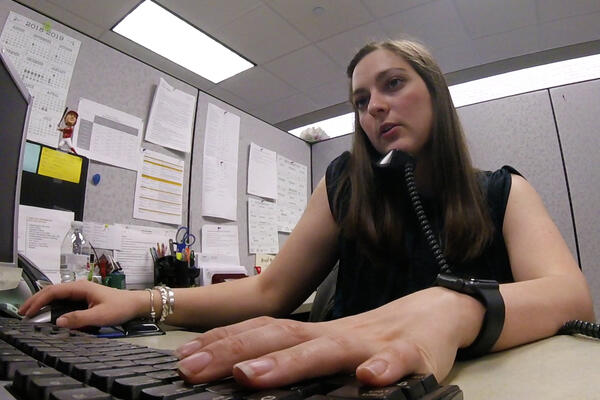
Olivia Kriel has been working at WSRI for three years. During that time, she has consistently asked for additional responsibilities to increase her knowledge of their Human Resources Department. She has created and distributed a monthly all staff newsletter, mentored and supported other student interns within the department by providing guidance and backup support when needed.
Olivia served as the main point of contact for the summer Automatic Target Recognition Center (ATRC) internship program hosting over seventy STEM students from across the country conducting research with Air Force Research Laboratory (AFRL) mentors on the Wright State campus. She was responsible for all the pre-internship welcome communications, the on-boarding process, organizing orientation sessions, providing support during the internship, and conducting the exit process and final communications when the internships ended. The feedback from the program’s manager regarding Olivia’s performance was glowing.
Olivia has established herself as the “go to” resource for HR or operational questions and issues for many of the WSRI staff. Her supervisor Liz states, “Having Ms. Olivia Kriel on my team makes me a more successful leader and the WSRI a better place.”
Congratulations Olivia!
Special thanks to this year’s selection committee: Dalila Bennett; Medical Student Clinical Coordinator, Boonshoft School of Medicine; Kurt Brugger, Assistant IT Manager, Boonshoft School of Medicine; Chelsie Spoor, Graduate Assistant, School of Public and International Affairs.
Congratulations to all the students who were nominated this year and thanks to all the supervisors for nominating their outstanding student employees.


Biography:
Nomination submitted by Kirby Underwood, Chemistry Department.
Nathan Northern has been working in the chemistry lab since 2014 preparing apparatus and chemicals for appropriate use in general chemistry teaching labs and chemical demonstrations. He has assumed a leadership role by training and mentoring new employees in the lab, served as a role model for the other students to push themselves to learn and excel, and made himself available to respond to other employees’ questions.
Nathan led discussions on process improvements and demonstrated initiative by taking safety and other pertinent training modules prior to being asked. He is always ahead of schedule on tasks and immediately begins planning the next task.
The contributions Nathan has made to the chemistry lab will have positive implications for years to come.
Congratulations Nathan!
Special thanks to this year’s selection committee:
- Seth Bauguess, Director of Communications;
- Jennifer Turpin, Assistant Director, Fitness and Wellness Campus Recreation;
- Harolyn Williams, Academic Advisor, Pre-Health.
Congratulations to all nominees and thanks to all the supervisors who took the time to nominate their exceptional student employees.


Biography:
Nomination submitted by Dr. Silvia Newell, Earth and Environmental Sciences.
Justin Myers began working as a Research Technician in the biochemistry lab over a year ago. His natural aptitude for more meticulous work with chemicals, math, and machinery quickly became apparent. He currently functions as a lab manager and is in charge of lab equipment.
Justin has saved the lab thousands of dollars in equipment repairs by diagnosing and repairing problems with some very sensitive lab equipment. He can take apart, repair, and reassemble sensitive lab equipment such as the mass spectrometer.
Although an undergraduate, he has trained all of the graduate students on the lab equipment and is the “go-to-guy” for troubleshooting and repairs of the lab equipment. The graduate students seek him out to answer questions about lab protocols and nutrient data.
He also excels in the field and will go the extra step without being asked, wading out in a river to collect cores or fixing the meters when they break in the field.
Justin is very dedicated. He will work extra hours to help other students, volunteers to stay late to finish a project and frequently comes in early to run more samples.
Justin has a deep appreciation for the natural environment. He is an enthusiastic nature photographer and one of his photographs was published in the 2016 Ohio Travel Guide.
Congratulations Justin!
Special thanks to this year’s selection committee:
- Julia Acosta, Program Coordinator, Leadership Studies in Education;
- Ryan Black, Budget Manager, Associate Provost;
- Chris Hogan, Assistant Director, Community Standards and Student Conduct.
Congratulations to all nominees and thank you to all those supervisors who nominated their exceptional student employees.


Biography:
Nomination submitted by Amanda Watkins, Veteran and Military Center.
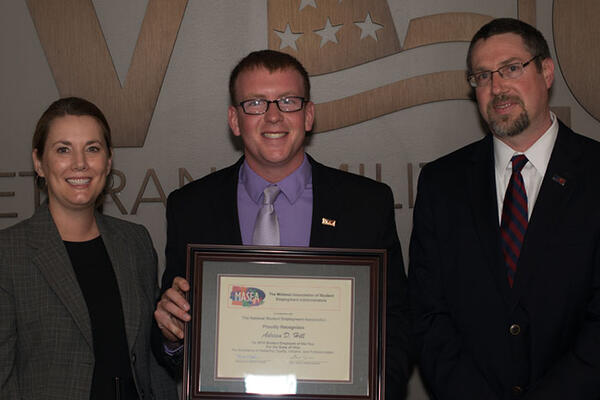
Adrian Hill began working at the Veteran and Military Center (VMC) in the spring of 2014, as the Veterans' Voices Project Coordinator. At the time of his nomination, he and his project crew had completed almost 30 interviews, which were sent to the Library of Congress. Adrian planned and implemented screenings for the project as a way to recruit volunteers and make students aware of a Veterans' Voices class being offered for summer 2015.
Adrian oversees the work of others creating and editing stories for broadcast and streaming via the local National Public Radio affiliate, WYSO-FM. For his work with Veterans' Voices, Adrian has been featured in the Dayton Daily News, Troy Daily News, and the Wright State Newsroom, resulting in veterans and their families reaching out to Adrian for interviews.
Adrian connected the VMC to the Montgomery County Veterans Services Commission, for collaboration on a scholarship for student-veterans. Adrian brought the Dayton Veterans Administration and local veterans organizations to campus, facilitating connections for student-veterans.
In August 2014, Adrian was appointed by Governor Kasich to the Ohio Commission on Service and Volunteerism, where he votes on decisions affecting community service and volunteerism in Ohio.

Biography:
Nomination summited by Alaine Dunn, Emergency Medicine Department.
Benjamin Clouse has worked in the Department of Emergency Medicine (DEM), Boonshoft School of Medicine since January 2013. In just over one year, Ben has become an invaluable member of our DEM team and all of its functions. Our faculty and administrators often comment on Ben’s many positive contributions to the department, his professionalism, and how well he represents the Department to those both inside and outside the School of Medicine and Wright State University itself. On many occasions, I have seen him give 100% for several hours in preparation for an event and then being the last one to leave. He is dependable and reliable beyond what you would expect from a busy student—especially one carrying up to 20 credit hours a semester while maintaining a 3.9 GPA.
For example, in addition to the routine office duties, he has eagerly participated in high-fidelity medical simulation sessions. He has worked with technicians to set-up for these training sessions and participated in scenarios as stand-in nurse or medical technician in teaching simulations. In some cases performing CPR for back to back demonstrations for several hours has been required. Though exhausting work, he seemed energized. Ben has also accompanied the CIMER training team to main campus for low fidelity simulations for medical students and nursing students. In addition, he participated in a “terrorism re-enactment” staged for training purposes working with the Ohio State Patrol. The degree of reliability, work quality and professionalism that is a prerequisite for such a community activity is rarely seen in a student worker, yet Benjamin Clouse exceeded expectations.
Ben Clouse has been a remarkable asset to our Department and Wright State University. This is due not only to his work ethic and accountability, but also because of his personal character. He is respectful to others and sensitive to areas of confidentiality. He shows compassion, understanding, and is of even temperament--characteristics of necessity particularly when working with medical education.
Career Services congratulates Benjamin on his professionalism, hard work, and dedication to Wright State University!
A special thanks to this year's selection committee:
- Linda Hockaday, Assistant Director, Student Services
- Iris Mirelez, Associate Director, Student Enrollment Services Raider Connect
- Jack Pence, Assistant Director, Student Activities


Biography:
Nominated by Dennis J. Hance, Mechanical Engineering Program.
Kris earned the award as Student Employee of the Year due directly to his outstanding work habits and willingness to ‘do the extras without being asked’. He recognizes what needs to be done – and does it!
We congratulate Kris on his professionalism, hard work, and dedication to Wright State University - Lake Campus.
A special thanks to this year's selection committee:
- Drew Corbett, Associate Director of Campus Recreation;
- Jacqueline S. Robinson, Director, Business Support Services;
- Michael LaTorre, Graduate Student, Student Affairs in Higher Education.

Biography:
Nominated by her supervisor, Dr. Hank Dahlman, Professor of Music, Director - Choral Studies, Director- CELIA (Collaborative Education, Leadership, and Innovation in the Arts).
Exemplifying reliability, quality of work, initiative, professionalism, and uniqueness of contribution.
Ashley's Contributions to Wright State
In his nomination letter, Dr. Dahlman outlined some of Ashley's accomplishments in the Department of Music:
"Choral Library Renovation
"During the summer of 2011, in preparation for the new building project to renovate Schuster Hall in the Creative Arts Center, we needed to free up space in the Music Wing. That summer, Ashley, along with the junior level UCA Jeeremy Bon, completely renovated and re-ordered the entire choral music library. This included culling out-of-date and/or out-of-print, and obsolete scores from the files of over 1,000 choral octavo titles (small works) and over 200 major works and anthology titles and other book-format materials. While doing so, Ashley designed and entered data for a completely revised and computerized choral library database, replacing the antiquated and inaccurate card files. She and her student assistants (many of them volunteers that she personally recruited) also completely revamped the library work areas and office space, and oversaw the installation of new shelving in the library, following up with a complete re-filing of all the remaining choral titles. This was a HUGE job, and it was done extraordinarily well, with minimum faculty supervision. In my opinion, this alone should merit an award for Ashley.
"Coordinated registration: 2010 and 2011 Mad River Vocal Arts Festivals
"This event involves registrations from over 125 high school students representing some 25 or 30 high schools each year. Registration involves in-take and database recording of registration forms, collection of fees and delivering these the same day to the Departmental administrative assistant in charge of accounts payable, and regular contact with school directors, students, parents, and public school officials, bookkeepers, and other administrative personnel. Since this is a major recruiting event for us, it is essential that this task be handled in a highly accurate, timely, and positive and friendly way (i.e., "customer service"). Because of this, I typically have assigned this task to a graduate assistant or WSU staff member, but in this case, I had every confidence that Ashley would do an outstanding job. She absolutely delivered, and then some. Some would say it was the smoothest festival we'd ever had, and I'd agree.
"Choral Assistant for Bernstein MASS with the Dayton Philharmonic
"Last May, the WSU Choral Program, in collaboration with the Department of Theatre, Dance & Motion Pictures and the Dayton Philharmonic Orchestra, presented a fully staged performance of MASS by Leonard Bernstein. The performances were the result of over three years of planning, and involved over 200 singers, instrumentalists, actors, dancers and technical crew. Over 80 choral singers from three different WSU choirs were involved. Ashley, along with graduate teaching assistant Amanda Hughes, oversaw all library and logistical matters pertaining to score acquisition, distribution and retrieval. The choral scores were only available as rental scores, EACH score costing $125 if not returned. Thus, we were responsible for the distribution and return of over $10,000 worth of rented scores. Ashley organized the whole thing, closely coordinating with the DPO Librarian. Needless to say, we got all the scores back from students, safely returning the scores to the DPO by the deadline.
"Choral Tour Manager
"Presently, Ashley is working as the Tour Manager for the Collegiate Chorale's presentation at the Ohio Music Education Association Professional Conference and our Spring Tour to Washington, DC and Virginia, which includes performances at the National Cathedral and Colonial Williamsburg. We will sing later this summer at the Champions Level of the World Choir Games, hosted this year for the first time in the US (as it happens, Cincinnati). As Tour Manager, Ashley is responsible for coordinating rooming lists, and contacting host organizations, providing lists of repertoire, and generally assisting me with the myriad of tasks and details, and often under strict deadlines. This is the smoothest year we've had in this regard, and yet the busiest, in over 5 years. No accident."
Congratulations and thank you, Ashley Leasure!

Selection Committee
A special thanks to this year's selection committee:
- Jenny 'Alex' Alexander, Lecturer, Department of Communications;
- Jen McCamis, Associate Director, Undergraduate Admissions;
- Liane Muhlenkamp, Program Officer Assistant for Teacher Education, Lake Campus.
Congratulations to all nominees!
Thank you to those supervisors who participated in this year's program and nominated their excellent student employees

Biography:
Nnominated by his supervisor Marcia Wendeln, Department of Biological Sciences, College of Science and Mathematics.
Exemplifying reliability, quality of work, initiative, professionalism, and uniqueness of contribution.
Matthew Porter began attending Wright State University in January 2007 and is completing his Bachelor of Science degree in Earth and Environmental Sciences this fall. He was hired in the Freshman Biology Lab in the Spring 2007 and in 2 years became the most senior lab assistant. Matt continually looks for ways to improve the educational quality of the labs. He has been instrumental in creating new lab experiments and adapting them for the needs of students with disabilities. Additionally, he has taken on an informal leadership role by training new student employees, serving as a mentor for other assistants, and supervising the growing number of outreach programs for the lab. Some of these programs include the STEMM Exploring Science program for middle school students, Tech-Fest at Sinclair Community College, Take Our Sons and Daughters to Work Day at WSU, STEMM Summer Camp for students with disabilities, and several workshops for home-school groups. His dedication, resourcefulness, and leadership have resulted in extremely successful programs.
Matt takes initiative in several aspects of his job by improving lab equipment, fixing microscopes, designing methods to make experiments more effective, and searching on his own time to find materials that will help students' performance in the lab. A specific example of Matt's initiative is organizing a small team of student employees to re-build the Biology Department's dilapidated bird blind. He also got the group to commit to providing the labor and materials. Marcia Wendeln wrote in her nomination letter: "With some funding from the Dept. of Biological Sciences, Matt took the lead and they completely rebuilt the bird blind from only a frame, replacing the roof, walls, benches, and feeders. He brought in his own tools, picked up supplies with his car, and worked on Saturdays and evenings without pay to make sure the job was done. He also was instrumental in obtaining some donated supplies from Home Depot and Lowes. Although other students have helped with this project, we would not have a new bird blind in the WSU woods if it was not for Matt's extensive effort and long hours of dedication."
A special thanks to this year's selection committee:
- Chris Murphy Assistant Dean for Student Services College of Education and Human Services;
- Charles Long Assistant Dean for Academic Services, College of Liberal Arts;
- Evelyn Lauterbach Academic Advisor, Lake Campus.
Congratulations to all nominees!
Thank you to those supervisors who participated in this year's program and nominated their excellent student employees:

Biography:
Nominated by Jean Denney, Assistant Director of Disability Services.
Exemplifying reliability, quality of work, initiative, professionalism, and uniqueness of contribution.
Brendan has worked in the Office of Disability Services for two and a half years taking on numerous roles and responsibilities. Brendan’s first position was as driver of the Wright State accessible minivan and his outgoing and friendly personality as well as his interest in working with students with disabilities quickly led to promotions to office assistant and programming assistant. And, he performed these duties with the responsibility and confidentiality of a professional staff member.
Brendan’s attitude and willingness to assist with whatever was needed led him to being promoted to roles with Starting Wright, a program developed as part of the Ohio STEM Ability Alliance grant which provides a webcasting program for high school students who are interested in STEM majors. Brendan aided staff in maintaining the technology needed in order to make this program a success. Additionally, Brendan served as the co-leader of the ODS Peer Mentoring program where he provided exceptional leadership by training peer mentors both in the classroom and at the low ropes course in Outdoor Recreation as well as planning and leading several off-campus activities for first-year students with disabilities and their peer mentors. He continued to co-lead the peer mentoring program for 2 years and developed and taught an academic course titled ED 101 – Mentoring Peer Mentors and Student Leaders for Students with Disabilities
Jean Denney, Assistant Director of Disability Services wrote in his nomination letter, “He quickly became everyone’s ‘go to’ student employee primarily because he was always willing to provide assistance and he never disappointed you with his ideas and follow through! Since his employment in Disability Services, Brendan has demonstrated exceptional work skills including exemplary reliability, initiative, quality of work, professionalism, and unique contributions to our department. We have been fortunate to have him work as a student employee in our department and his ongoing contributions in servicing students with disabilities.”
Brendan’s commitment, loyalty, passion, strong work ethic, and friendly disposition area qualities truly valued by students and staff in Disability Services. He is a role model to other students. Brendan will graduate in June 2010 with an undergraduate degree in Organizational Leadership. He is currently making plans to pursue a graduate degree in Student Affairs in Higher Education at Wright State.
A special thanks to this year's selection committee:
- Joseph Berthiaume, Ph.D., Associate Director, Residence Services;
- Jennifer Thal, Graduate Student, Student Affairs in Higher Education;
- Gretchen Rentz, Student Services Specialist, Lake Campus.
Congratulations to all nominees!
Thank you to those supervisors who participated in this year's program and nominated their excellent student employees

Biography:
Nominated by Jacqueline Neal, Director of Biology and Pre-Health programs.
Exemplifying reliability, quality of work, initiative, professionalism, and uniqueness of contribution.
Nicole has worked for the Department of Biological Sciences for three and a half years in the Biology and PreHealth Student Services office. Nicole's outgoing and friendly personality quickly led to increased responsibilities in the very busy, high call volume, advising center. She immediately adapted to scheduling appointments for multiple advisors, creating newsletters to assist in communications between the department and students, implementing a new filing system for undergraduate files, and maintaining information sheets and curriculum guides for all undergraduate and graduate students.
Jacqueline Neal, Director of Biology and Pre-Health programs who has directly supervised Nicole during her student employment wrote in her nomination letter, “Nicole's responsibilities have not ended there. With her own interest in health care (she’s a majoring in Nursing), Nicole has approached things from a student’s perspective and has helped to develop a new website and organize seminars and workshops, including the annual “Path to Health Professions” event. This event hosts over 400 high school students and admission representatives from around Ohio. Because of Nicole’s contributions, these programs have soared to greater heights and current and future WSU students will benefit from her hard work and dedication.”
Nicole’s commitment, loyalty, passion and bubbly personality are qualities truly valued by faculty, staff and students. With her strong work ethic and ability to multi-task, she serves as a role model and mentor to other student employees.
Nicole grew up on a farm in the small town of Glandorf, Ohio and is a graduate of Ottawa-Glandorf High School. She is planning to graduate in June and pursue a career in nursing, specializing in a high acuity field.
Nicole was recognized at a reception in Millet Hall on Tueday, April 14, during National Student Employment Week. Nicole is a “one-of-a-kind” and truly deserves this recognition. Congratulations, Nicole!
A special thanks to this year's selection committee:
- Kenneth L. Rosengarten, Ph.D., Assistant Professor of Teacher Education, Lake Campus;
- Barbara A. Conklin, Office Assistant, University Libraries;
- Matthew Thomas Skira, Community Director, Hamilton Hall Office.
Congratulations to all nominees!
Thank you to those supervisors who participated in this year's program and nominated their excellent student employees:

Biography:
Nominated by her supervisor, Judy Brewer, a faculty member in Education and Human Services at the Lake Campus.
Exemplifying reliability, quality of work, initiative, professionalism, and uniqueness of contribution.
Melissa Steinke, student employee in the Reading Center at the Lake Campus, was selected as Wright State University's Student Employee of the Year. In addition, Melissa competed at the state level and was selected as the winner for the state of Ohio!
Melissa was nominated by her supervisor, Judy Brewer, a faculty member in Education and Human Services at the Lake Campus. She was recognized at a reception at Lake Campus on Thursday, April 17, 2008, during National Student Employment Week. Her co-workers had the opportunity to congratulate Melissa at a private reception following the presentation hosted by Career Services.
Below is an excerpt from Melissa's nomination letter written by her supervisor, Judy Brewer:
"Melissa Steinke is a senior at Wright State University-Lake Campus, majoring in Middle Childhood Education with concentrations in Math and Science. After graduation this spring, she will complete her fifth year at the WSU-Dayton Campus, while also working toward obtaining her K-12 Reading Endorsement.
"As a student assistant in the Lake Campus Reading Center, Melissa works long hours and is responsible for a variety of important tasks. For three years, she has worked maximum hours for the Reading Center (days, nights, summers, and every Saturday morning during the academic year) while also completing her class requirements in exemplary fashion — her current GPA is 3.609. She is also a published author, and she is an active volunteer for the Shelby County Big Brothers, Big Sisters program.
"For the Lake Campus Reading Center, Melissa is responsible for monitoring student enrollment, which involves processing forms, confirming enrollment with parents and maintaining confidential files. She also arranges student assessments, which again involves parent interaction. In addition to students and parents, she corresponds with school administrators to arrange assessment sessions, and she often travels to the schools to act as an on-site supervisor for those assessments.
When I think of Melissa, I think of a hard worker with a determined spirit … I also think of her as a future ‘Teacher of Excellence.’ This is a young person who wants to make a positive difference."
A special thanks to this year's selection committee:
- Marc DeWitt, Graduate Assistant, Enrollment Management;
- Liane Muhlenkamp, Program Assistant, Teacher Education, Lake Campus;
- Dr. Donna Schlagheck, Chair/Professor, Political Science.
Congratulations to all nominees!
Thank you to those supervisors who participated in this year's program and nominated their excellent student employees

Biography:
Nominated by Dr. David Lee Garrison.
Exemplifying reliability, quality of work, initiative, professionalism, and uniqueness of contribution.
Scott DeHart is a sophomore pursing a degree in management with a minor in French. Scott works as a student assistant in the Department of Modern Languages. Conducting language placement tests, greeting visitors to the office, responding to numerous and various inquiries, and drafting correspondence are just a few of his duties in Modern Languages. The department values Scott’s creativity, initiative, and his ability to treat everyone with respect and courtesy.
Originally from Chillicothe, Ohio, Scott returns to his high school to promote the importance of taking foreign language classes. He is a 2005 graduate of Unioto High School. Scott’s career goal is to work for an international organization blending his skills and knowledge of management with the French language.
Award Winning Service
In excerpts from his nomination letter, Scott Dehart's supervisor Dr. David Lee Garrison describes how valuable and effective Scott is as a student assistant in the Department of Modern Languages:
"Scott is the most mature, polite, professional and dedicated student worker I have ever seen. He greets people, on the phone or in the office, in a way that makes them feel at ease; he listens to them and quickly ascertains what they need.
"Scott is incredibly creative. When things were slow in the office for a week or so one time, he invented a computer game to learn vocabulary words in a foreign language that our whole faculty uses.
"’Above and beyond the call of duty’ is Scott DeHart’s middle name. In addition to working in our office, he does things like go to our Majors and Minors Meetings to help us put out refreshments and clean off the tables when meetings are over.
"Scott averages 30 hours a week in our office and is active in many extracurricular activities, and yet his grades never suffer. He is majoring in management with a GPA of 3.93. Scott does everything well."
A reception, held on April 9, 2007, during National Student Employment Week, recognized Scott for his selection as Wright State’s Student Employee of the Year. Dr. Dan Abrahamowicz presented Scott with a Wright State University watch and a certificate recognizing Scott’s contribution to Wright State and the Department of Modern Languages. Scott also received a gift certificate from the office of Career Services recognizing his selection as the Student Employee of the Year.
Congratulations, Scott, for your dedication and efforts on behalf of the Modern Languages Department.

Biography:
Nnominated by her supervisor, David Jones.
Exemplifying reliability, quality of work, initiative, professionalism, and uniqueness of contribution.
Amanda Smith was selected as the 2006 Wright State University Student Employee of the Year.
Amanda is a junior Social Work major and business management minor at Wright State University. She is currently in the Honors program with a 3.7 grade point average. Originally from Dayton, Ohio, Amanda is a 2003 graduate of Stebbins High School.
Amanda was nominated by her supervisor, David Jones in Center for Urban and Public Affairs, where she has been a student employee since the fall of 2003. She began as a telephone interviewer in the survey research lab, conducting surveys on behalf of governments and non-profit organizations. In the two and half years that she worked for the research center, she has been promoted to supervisor of the survey lab and has had the opportunity to work in different capacities on numerous research projects that the Center has conducted.
While a student at Wright State, Amanda has taken part in the Peer 2 Peer program and has served as a tutor for the Ohio Reads program. She is an active member and former treasurer of the American Humanics Student Association, a non-profit certification program on campus. She is also a member of the American Association for Public Opinion Research (AAPOR), a national organization dedicated to excellence in survey research.
Here is an excerpt from Amanda's nomination letter written by her supervisor, David Jones:
"After completing a research project in 2004 about the impacts of high school preparation on student success, Amanda expressed a desire to explore the topic further. With this is mind, she and a fellow CUPA employee developed a 65 question survey aimed at exploring the role of high school preparation on student career and college planning. In order to ensure the validity of her survey, Amanda sought out the expertise of many WSU faculty and staff members to gain their input.
"Using Southwest Ohio as her target area, Amanda developed a sound methodology to obtain a representative sample of all public high schools in Southwest Ohio. After having her survey and methodology approved by the University's review board, she began contacting her target schools in order to gain permission to conduct her research.
"Today Amanda's survey is being implemented at more than 40 high schools in southwest Ohio. In all, between 4,000 and 5,000 high school juniors and seniors will take part in this survey. Many high schools Amanda has worked with have expressed a desire to conduct this survey on an on-going basis in order to measure the impact of changes each school may make as a result of survey findings. This in itself has positioned Wright State University to be at the forefront of education research for many years to come.
"After data collection is complete, Amanda will enter and analyze the completed surveys, and will prepare a journal article that she plans to submit for publication in late 2006. Additionally, Amanda has applied for and has been accepted to present her findings at the American Association for Public Opinion Research (AAPOR) conference in Montreal in May of 2006.
"While these attributes are impressive, what I believe truly sets Amanda apart from other students is that she has conducted this research strictly in pursuit of knowledge. She took the initiative to seek out funding for her research and for her travel to the conference, as our office would have been unable to provide all financial support. While our office has been very supportive of this research project, Amanda has been responsible for its success. She has truly been a leader in advancing research at Wright State, and for that I believe she should be recognized."
A reception was held during National Student Employment Week in the Millett Hall Atrium. Wright State University Provost Dr. David R. Hopkins presented Amanda Smith with a certificate and several gifts. Julie Todd, Career Services Assistant Director presented Amanda with a gift certificate and a check from Midwest Association of Student Employment Administrators (MSEA) for winning at the state level. Congratulations Amanda for a job well done!
Biography:
Nominated by Steve Farrell.
Exemplifying reliability, quality of work, initiative, professionalism, and uniqueness of contribution.
Kristin Megan Watts has worked as a Student Environmental Health Technician since the fall of 2003. Her main responsibilities include weekly analysis of chlorine levels and coliform sampling of Wright State's drinking water and maintenance of records of infectious waste production, recycling inventory, storm water discharge, and storage of hazardous chemicals.
Her supervisor, Steve Farrell says, "Kristin has been able to perform all her duties with little need for anything more than introductory direction. She is always able to take on a task and complete it in a timely and thorough fashion. The quality of her work always shows through."
Dr. Dan Abrahamowicz presented the Student Employee of the Year Award to Kristin on Monday, March 28, 2005, in the lobby of Millett Hall. Her co-workers were able to congratulate Kristin following the presentation, at a reception hosted by Career Services.
In addition to her student employment responsibilities, Kristin has been a member of Alpha Lambda Delta Honor Society, National Collegiate Scholars, Golden Key International Honour Society, Alpha Xi Delta Sorority, and Habitat for Humanity. She plans to begin graduate school in the fall.
Thank you to all students participating in the Student Employment Program at Wright State University. Your work is valued and your efforts are appreciated.
Student Employee Evaluations + Form
Student employees should be evaluated by the student's immediate supervisor at least once a year. The evaluation form should be signed by both the student and the supervisor. A generic evaluation form is provided by Student Employment; however, departments may design forms specific to their students' positions. Retain copies of the evaluations in the departmental files.
Student Employment Evaluation Form (PDF)
Separation, Termination & Grievance Procedures
For details, visit On-Campus Student Employment: Separate, Terminate, Verify
Information related to On-Campus Student Employment includes Job Postings & Student Eligibility, Hiring Process, While on the Job, and Separate, Terminate, Verify Student Employment.