On this page:
- Guidelines
- Color systems
- Primary color palette
- Secondary color palette
- Tertiary color palette
- Additional color information
Guidelines
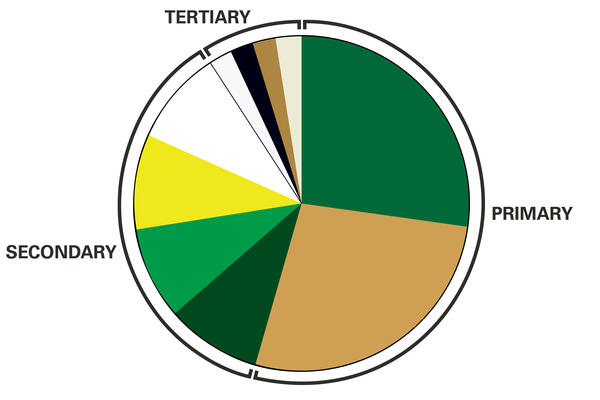
Our color palette is divided into three groups: primary, secondary, and tertiary.
Our primary palette should always lead, while the secondary and tertiary palettes add depth and support to our communications and marketing.
The primary print color palette is the official Wright State green and gold and should be used prominently and dominantly. White can be used as an auxiliary color when needed (such as the biplane logo appearing in white on a dark background).
The secondary and tertiary palettes are to be used only to support and complement the primary color palette. They were designed to work with the Wright State green and gold, and should only be used to provide visual interest. This ensures a more consistent use of color across all marketing and communications.
The Wright State colors and brand must be recognizable and prominent. Avoid color combinations that could represent other universities and colleges.
Do not build a layout around secondary colors. If the project does not look like it comes from Wright State, it is a violation of the university's brand.
These colors are authorized for use on the web and for other digital media, such as email, Microsoft PowerPoint presentations, video, electronic newsletters, etc.
Embroidery thread color recommendations can be found on Merchandising and Licensing.
Color Systems (PMS, CMYK, RGB/HEX)
To ensure your color values display correctly and are consistent, be sure to always choose the appropriate color system for the intended use of your communication. When used improperly, inaccurate display of colors will result. For example, PMS colors are not used on a website as RGB colors are not used on a printing press.
Microsoft applications allow for the use of CMYK and RGB (under Theme Colors, and then More Colors in the Menu). To ensure the right color mode is applied, use CMYK for Microsoft Word (printing) and RGB for Microsoft PowerPoint (onscreen/digital).
Onscreen (digital) colors have been formulated to ensure appropriate color contrast between text and backgrounds to maintain legibility for all readers. This in turn makes our digital materials accessible to those with low vision, colorblindness, and other disabilities.
PMS (Pantone® Matching System)
PMS colors (also called Pantone® colors) are standardized color inks made by the Pantone company and are used for spot-color materials and standard offset printing. This system ensures designers and printers use the same PMS color, creating consistent print items.
Do not use PMS for onscreen (digital) purposes.
CMYK (cyan, magenta, yellow, black)
CMYK color (four-color) is a method where a combination of these four colors to build other colors. These tend to be used when PMS is not available, but are not a true match to PMS colors. CMYK color is used in standard offset and digital printing.
Do not use CMYK for onscreen (digital) purposes.
RGB (red, green, blue) and HEX
This colors are used for digital applications such as social media, powerpoint presentations, TV screens, mobile devices, and so forth. RGB is a process by which colors are rendered onscreen by using combinations of red, green and blue. HEX is six-digit combination of numbers ideal for websites and web development.
Do not use RGB or HEX for print purposes.
The color palette listed below has PMS and CMYK values formulated for print purposes, and RGB and HEX values formulated for onscreen (digital) purposes.
Primary Color Palette
Wright State Green
Wright State Gold
Secondary Color Palette
Dark Green
Bright Green
Highlighter Yellow
White
Lake Campus Use Only
Lake Blue
Tertiary Color Palette
Deep Gold
Off White
Black
Faded Gold
Additional Color Information
More detailed information, including additional hex codes and color formulas, is available in the Lytho Brand Center.
Log in to Lytho Digital Asset Management through the Lytho DAM site. Select Login with SSO Account to use your WINGS login information. If you’ve already logged in to WINGS, you’ll bypass the login and be directed to your Lytho DAM Dashboard.