
Campus Visit
Discover Lake Campus and learn about our academic and service buildings, athletics and recreation, campus highlights, dining, and campus apartments. You can schedule an in-person visit or attend a virtual information session by viewing information here.
Academics
At Lake Campus, you can choose from nearly 30 bachelor’s and associate degrees programs as well as a master’s degree program in business administration (M.B.A.). You can also begin nearly any of the 100+ undergraduate programs offered at our Dayton Campus. Our academic advisors will help you explore majors and plan a path to graduation. Explore some of the majors today and let's see what great things we can do together.
Are you a transfer student? Check out the transfer scholarships we offer and your next steps if you are interested in Wright State.
Invest in Yourself
A 2023 Lightcast study indicates Wright State bachelor’s degree graduates earn on average $28,1000 more per year than someone with only a high school diploma—amounting to $1.2 million in higher earnings over a working lifetime. Are you ready to see how much further a Wright State degree can take you?
Get started today
VISITING AND NON-DEGREE SEEKING STUDENTS
Take a course at Wright State University and transfer that credit to another university where you are already enrolled! We've created an easy-to-follow checklist and enrollment process for you.
Success Stories
She’s having a love affair with Spain and may never break up.
Katelyn Umstead, an early childhood education major at Wright State University’s Lake Campus, has spent the past three summers at an education camp in Spain and hopes to teach abroad there after she graduates in the spring.
Umstead said she was bowled over by the “amazing” people and culture the moment she first stepped foot in Spain.
“I guess coming from a small town I enjoy the big cities,” said Umstead, who grew up in the western Ohio village of Coldwater. “And having warm temperatures most of the year is a big thing.”
Spain is the largest country in southern Europe, boasts a half dozen major cities — Madrid, Barcelona, Valencia, Seville, Málaga and Bilbao — and has 47 World Heritage Sites.
In the summer of 2017, Umstead worked at the Cei El Jarama educational camp in Telemanca de Jarama, a small municipality just outside of Madrid.
“You worked for 16 hours a day,” she said. “It was mentally and physically exhausting, but I would do it over again in a heartbeat.”
The camp, which was located on a farm, ended up being Umstead’s “home away from home.”
“They wanted me because I spoke English,” she said. “One of their goals is to teach kids English. They do English-immersion activities.”
Umstead returned to work at the camp in the summers of 2018 and 2019. She said the whole experience expanded her horizons.
“It opened my mind,” she said. “I’ve always thought of myself as an open-minded person, but that was before I left the United States. It made me realize that if I were to rely on other people to determine what I do with my future, I would always be in Mercer County.”
Umstead grew up with 10 siblings, most of whom lived together in the family’s four-bedroom house. Her father works at Fort Recovery Industries and her stepfather at Honda. Her mother is a social worker who once worked at Wright State and is now employed at a local nursing home.
“At one point we had two or three sets of bunkbeds that occupied all of the upstairs,” said Umstead. “But I felt fortunate. There was always somebody to talk to. There was always somebody to lean on or to fight with.”
After graduating from Coldwater High School in 2015, Umstead attended Xavier University in Cincinnati. Two years later she transferred to Wright State’s Lake Campus so she could live at home, save money and spend time with her family while she could because her goal is to teach abroad.
Umstead sees early childhood education as a way for her to help young kids.
“When I was in elementary school, I leaned on my teachers and let them be role models for me,” she said. “Of course, my parents were, but I just needed that extra attention, that extra push throughout school. That made me want to be that person for these kids in the future.”
Umstead said it is an opportunity to shape the students during their innocent age.
“It’s where you are able to help cultivate the students’ knowledge and what they learn and help give them the passion for education and the passion to want to learn, to want to be better and to be a positive influence on themselves, their family and the world,” she said.
Umstead credits Betsy Crites, education and STEM coordinator for Lake Campus Education and Human Services, for enabling her to gain experience through field placements at elementary schools and by teaching elementary students when they come to campus for STEM Days and other events.
Meanwhile, Umstead has her eye on graduation on May 2 and what comes next. She has already been accepted to teach at two schools in Spain.
Her advice to fellow college students considering an overseas experience is to just do it.
“Take that leap,” she said. “If you don’t, you’ll never know what you’re missing.”
It’s a three-minute walk to class for Katelyn Richardson, a sophomore nursing student at Wright State University’s Lake Campus.
Richardson is one of 100 students who live in the stylish, townhouse-style apartments that nuzzle up to Grand Lake St. Marys.
“The lake is awesome; it’s really pretty,” she said. “It’s not like most college campuses.”
Richardson lives in East Villa, new apartments finished last fall. The first apartments at Lake Campus were built in 2011, the second in 2013.
Richardson elected to live on campus to avoid having to commute from home, about an hour’s driving time each way. She lives with four other students, each of whom have their own bedroom and share a full, modern kitchen.
“I like how it is actually an apartment and not a dorm type of feel,” she said, adding that having her own bedroom gives her some privacy. “We can shut our door and really focus and study and don’t have to worry about outside distractions.”
The backyards are frequent gathering spots for playing football or throwing Frisbees.
Richardson usually spends her weekends on campus.
“You really get to know a lot of people and make new friends. Since everybody is right next door, it’s kind of like a big family,” she said. “…It just makes me feel like I didn’t go far; I’m still kind of at home.”
Richardson grew up in Alger, Ohio, a village of about 900 people east of Lima. Her family farms about 2,000 acres, growing corn and soybeans. Her mother is the director of Bethel Christian Pre-School.
After graduating from Allen East High School in 2016, Richardson enrolled at Wright State’s Lake Campus to study nursing.
“It’s just one of those things I always knew I wanted to do,” she said. “I’ve always been people-centered, and that’s really what nursing is.”
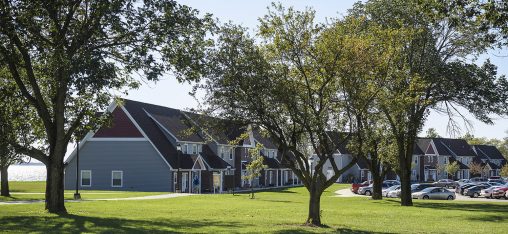
East Villa features private bedrooms for each townhouse’s resident, a full, modern kitchen and relaxing back porch that overlook the lake.
Richardson works at a nursing home in Cridersville and substitute teaches at Bethel Christian Pre-School.
She wants to get her bachelor’s degree in nursing and then her master’s so she can become a nurse practitioner, an advanced practice nurse who has more clinical independence and authority than some other types of nurses.
Richardson would like to use her nursing skills on medical mission trips. She has already been on two mission trips to a Navajo reservation in Arizona and one to Haiti.
Richardson’s nursing classes are small, enabling her to meet one-on-one with the professors if necessary.
“If I need to talk to a professor, I can just walk on over,” she said.
Farming is in her blood. And once she graduates with a degree in agriculture from Wright State University’s Lake Campus, Olivia McDade wants to earn a master’s degree in agricultural economics at Purdue University.
But she will likely be back.
“I want to return to Ohio and work for an agriculture marketing group and possibly get involved with Wright State’s agriculture department,” she said.
In 2008, Lake Campus began offering agricultural elective courses that were part of existing degree programs. Five years later it began offering associate and bachelor’s degrees in technical and applied studies with an agriculture concentration.
Previously, local students interested in pursuing careers in agriculture had to go off to college in Columbus, Wilmington or Wooster or make long commutes there. With a program at Wright State, they could further their education while remaining active on their own farms.
Today, more than 65 students are enrolled in the agriculture program. Courses include topics such as animal science, animal health, nutrient management and agriculture finance.
McDade grew up on the family farm in rural Darke County, east of Greenville. She and her family farmed 20 acres and raised 120 head of sheep.
“Obviously, there is a lot of hard work that goes into working on the farm,” she said. “It definitely taught me a lot of responsibilities and work ethic.”
Growing up on a farm was a big factor in McDade pursuing agriculture. At Greenville High School, she was active in National FFA and 4-H.
After graduating in 2016, McDade enrolled at the Lake Campus. She wanted a university that offered a four-year degree, was affordable and was close enough so that she could continue to work full time on the farm.
“I really like it here,” said the sophomore. “The class sizes are small enough that I’m able to get that one-on-one time with professors.”
McDade also works part time for the Champaign, Clark, Darke and Miami County Farm Bureau in Troy, helping plan and coordinate events and working with local legislators on agricultural issues.
Last May, ground was broken at Lake Campus for the Agriculture and Water Quality Center, which is expected to be completed in February. The $3 million, 8,190-square-foot center was bankrolled with $1.5 million in state funds and the rest raised by Wright State.
The center will provide classroom space for the growing agriculture program; a hands-on research and laboratory area for applied learning and research on agricultural and water quality issues; an outreach facility for community meetings on agricultural production, water quality and other issues; and a focal point for partners to work proactively to support the regional agricultural industry as well as water quality efforts associated with nearby Grand Lake St. Marys and local watersheds.
The building will include two education classrooms that each seat 24 students and can be combined into one large educational/conference room. Agricultural education lab space designed for diverse hands-on agriculture education activities and research will have seating for up to 24 students. A lobby and conference area will be used as a student lounge and a space for events and conferences for up to 100 people.
“It’s going to offer a lot more hands-on learning, having the labs to work with,” said McDade.