| |
|
| Abinash Agrawal |
Treatment
techniques of contaminated groundwater by metallic reductants (zero-valent iron
or ZVI, bimetallic Pd/Fe and Pd catalysts); study of the biogeochemical
processes in a constructed wetland designed for treatment of organic
pollutants (chlorinated ethenes or CEs); role of wetland plant rhizoshpere
in destruction of CEs. |
| Christopher Barton |
Statistical quantification
of complex earth processes, such as, mathematical approach for predicting
the size and number of undiscovered recoverable hydrocarbon reservoirs,
predicting the size and number of hurricanes, forecasting river flooding,
etc. |
| Huntting Brown |
Environmental law; sustainable
development; environmental science education |
| Allen Burton |
Aquatic toxicology: development and standardization of toxicity methods; ecosystem risk assessments: methods for identifying significant effects and stressors in aquatic systems |
| Songlin Cheng |
Geochemistry of natural
waters (lakes, wetlands, and ground water); application of light isotopes
in hydrological and hydrogeochemical investigations; environmental application
of geographic information systems |
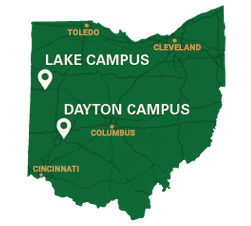
Charles Ciampaglio
(at Lake Campus) |
Paleobiology and macroevolution; echinoderm and chondrichthyan evolution and systematics; vertebrate paleontology |
| David Dominic |
Scales and controls of aquifer
heterogeneity in sedimentary units; geostatistical quantification & improvements
in the sedimentary facies models for quantifying lithology distribution;
numerical modeling of depositional processes; Upper Pennsylvanian-Lower
Permian sandstones |
| Bryan Gregor |
Earth & environmental
science education; modeling the global sedimentary cycle and geochemical
processes |
| Chad Hammerschmidt |
Mechanisms and processes that affect the transport, transformation, and fate of mercury and other trace metals in the environment; biogeochemistry of mercury and methylmercury in arctic and temperate watersheds, marine systems, and the atmosphere |
| Ernest Hauser |
3-D and 4-D geophysical
imaging methods; integration of seismic reflection and ground-penetrating
radar; Precambrian geology and tectonic evolution of the US mid-continent;
Detection/mapping of old coal mines using scattered in-seam seismic waves |
| Allen Hunt |
Theoretical methods for
reliable prediction & description of uncertainty in disordered systems:
mainly for the prediction of hydraulic conductivity, unsaturated flow,
resistivity, etc; stochastic theory of sediment entrainment in turbulent
flow |
| Robert Ritzi |
Geostatistical analysis
and modeling of sedimentary formations particularly with regard to aquifers:
method development to relate the spatial correlation statistics of permeability
distribution in a cross-stratified unit to its hierarchical aquifer architecture |
| William Slattery |
Critical elements in teacher
education; development of actualistic activities to involve elementary
and secondary school students in learning Earth Science. Sequence stratigraphy
of active (foreland basins) and passive margins in the eastern seaboard
of the US |
| Rebecca Teed |
Effectiveness of learning
activities, e.g., listening, hands-on science, and quizzes; effect of
prior knowledge on classroom learning. Inferring vegetation changes using
fossil pollens and charcoal in lake sediments; diatom study to characterize
geological changes in lake chemistry |
| Doyle Watts |
Seismic data processing
and interpretation; 3-D data interpretation data projects; new methods
of seismic data processing by wavelet transform. Analysis of satellite
data to map Gypsy Moth infestations in OH, WV & MI. |
| Byron Kulander |
Fracture analysis: regional
and local systematic and non-systematic fracture sets and their relative
ages in Cambrian through Pennsylvanian rocks in WV. Investigation of gravity,
magnetics, and structure of the Rome trough basement feature in WV |
| Benjamin Richard |
Mapping
of the buried pre-glacial surface in Ohio; geophysical studies of the
subsurface beneath the Cedar Bog wetland; geophysical delineation of
deep structures: application of gravity measurements to locate small
buried erosional remnants |
| Paul Wolfe |
Geophysical techniques
to study aquifer anisotropy to infer preferred ground water flow directions;
magnetic and acoustic characteristics of unexploded ordnance (UXO); structure
in the Precambrian basement by the seismic reflection to understand the
Grenville Front and sedimentary basins. |