|
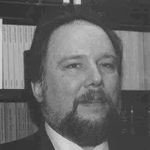
Birthright: A Novel by Andrew Coburn
[This review appeared in Christian Century.]
Reviewed by Martin Kich
The premise of Birthright might seem like something generated at a workshop for conspiracy theorists. Imagine that all of the perfidious possibilities in the last half-century's thick chronicle of crime have been wholly exhausted and that the participants have been forced to dig more deeply into the collective blurry memory. Then someone asks, "What if the Lindbergh baby wasn't really killed?" Coburn's premise is that Rudy Farber, an acquaintance of Richard Bruno Hauptmann, has orchestrated the kidnapping, involving a longtime friend named Joseph Shellenbach and Hauptmann in only parts of the plot so that if either is ever questioned about the crime by investigators, he will not be able to reveal all of the details. In fact, Hauptmann knows nothing about Shellenbach--only that there is someone else involved. In Coburn's version of the events, Hauptmann's role is restricted to making the ladder and collecting the ransom. Farber does the actual kidnapping, and he later tells Hauptmann that the other man involved dropped the boy when the bottom rung of the ladder broke and that the boy died from the injuries to his head. After Hauptmann foolishly spends some of the ransom and is arrested, he cannot implicate Rudy Farber or anyone else without confirming his own guilt. Shellenbach is interested in the boy, not in the money. His wife, Helen, who is mentally unstable, has dropped their own son in the bathtub and fractured his skull. So it is the Shellenbachs' dead baby whom Farber dresses in the Lindbergh baby's clothes and leaves in the underbrush along a roadside. The Shellenbachs drive out of New Jersey and just happen to stop in Haverhill, Connecticut, where they decide to settle. Shellenbach--called "Shell" throughout the novel--eventually becomes a reporter with the local newspaper. When their "son," called David, is still a boy, Helen gradually becomes so disassociated from everyday realities that she has to be institutionalized--though she is never so far gone that she reveals their secret. To Coburn's credit, he does not milk this circumstance (or any other) of all of its melodramatic possibilities. In fact, it is never clear that Helen's involvement in the "crime of the century" has caused her mental condition to deteriorate any faster than it would have under any other circumstances. In total, this novel is so far removed from the Robert Ludlum school of intricate plotting as it relates both to narrative structure and to political/corporate conspiracies that for substantial sections of the novel, one can almost forget the crime, much as the characters themselves almost forget it. And yet everything moves inexorably toward the moment when Shell, slowly dying of cancer, feels compelled to reveal the improbable truth to his son. The major strengths of the novel are Coburn's emphasis on character over event and the richness of his style. All of the characters in the novel are truly interesting, and even some of the minor characters continue to develop and to surprise. Shell's mother-in-law, Mrs. Dodd, initially comes across as a caricature of the tactless, unsparing bitch--the sort of mother who can be expected to have children as psychologically fragile as Helen and her gay brother prove to be. Yet, later in the novel, Mrs. Dodd emerges as a fascinating presence; her bitchiness can then be understood as an integral aspect of a strong personality that can be as attractive as it can be disconcerting. Instead of simply proving the first impression wrong, Coburn makes us see her more fully for who she is. Indeed, his characterizations are so skillful that even the Lindberghs come across as something more than the two-dimensional figures of American iconology. Coburn's prose style is straightforward without being self-consciously spare, literary without being pretentious, somewhat off-centered without being distracting. It seems perfectly suited to a story about characters for whom irony is an instinctive understanding rather than an affectation. And the narrative language is flexible enough to adapt to each character. At one point, Anne Morrow Lindbergh thinks of her husband literally and figuratively as "a long shadow on the groomed lawn." Somewhat later, her thoughts about her lost son are rendered in equally compelling terms: she thought of "heaven as Nebraska, where the only scenery is sky." In contrast, Gretchen Krause, a curvaceous woman with whom both Rudy Farber and Shell maintain long relationships, thinks on meeting a soldier at a USO club in Central Park: "She had never met anyone from Wyoming and wasn't sure it was a real state." Compulsive annotators will find something quite marvelous on just about every page. Even some of the more graphic language and scenes have a wry power. Of special interest may be the characterization of Father Henry, an Episcopal priest who is Shell's friend and eventually Mrs. Dodd's second husband. He can be described as Shell's confessor on stand-by, and he is perfectly suited to the role. His great compassion has a sardonic edge, though it has come at the cost of much of his faith. During his last visit with Shell, he reassures him by saying, "Soul is mind. Mind is essence. Without substance, there's no essence. You've nothing to fear." Sort of like Camus in a clerical collar--which by the way he wears on the flight north from Florida because he has observed that the stewardesses tend to be much more forgiving of old priests than of old men in general. A former investigative reporter, Andrew Coburn is the author of ten previous books, including three novels adapted as films noir in France. Birthright is a novel of considerable energy, imagination, and maturity.
|