WSU's Department of Biological Science has many facilities and resources both for class use and individual or group research projects. On this page there is information about the greenhouse, the forest bio preserve and experimental garden, and laboratory facilities and equipment available for use in plant-related research.
Greenhouse [NEW: Greenhouse Site ]
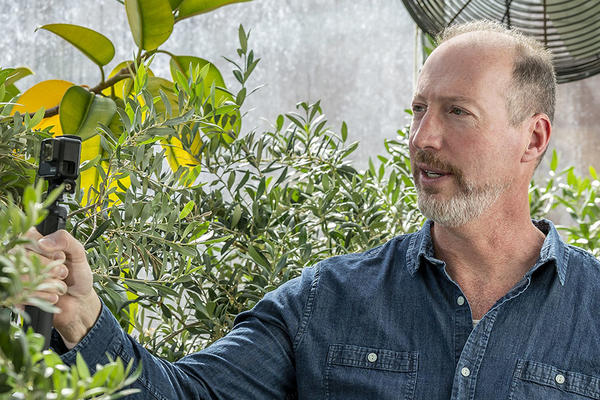
The greenhouse at Wright State University is located near the Biological Sciences Building, attached to Fawcett Hall. The greenhouse is used for instruction, research and the maintenance of a permanent teaching collection. It has 1000 square feet of growing space with a 400 square foot potting room/work area. Temperatures are regulated mechanically using ridge vents, evaporative coolers and natural gas heaters that are controlled by computer. The greenhouse is also equipped with shade curtains and supplemental lighting.
WSU Biological Preserve [NEW: Bio Preserve Site ]
The WSU Biology Preserve consists of approximately 60 acres of woods extending northeast of campus. The woods have several uses. It is an important nature reserve (one of the 3rd or 4th largest wooded areas in Greene Co.). They have been and continue to be the site for many research projects by both undergraduate and graduate as well as faculty members [see research].
The preserve is also utilized by several classes for course-related field work. There are about 6 miles of hiking trails making an important source of recreation for WSU students, staff and faculty. The bio preserve is an asset that is possessed by few other universities.
The Biology Department currently has access to nearly 700 acres of high quality wetlands in the ecosystem known as the Beaver Creek Wetlands. This resource is only 15 minutes from campus and many classes can take advantage of its accessibility. This wetland complex contains fens, marshes and forested wetlands (swamps) containing well over 470 species of plants. Many of the plant species are quite rare and are listed by the state as endangered or threatened. The rarest environments are the fens. These wetlands are defined by their groundwater dominated hydrology, high conductivity water, richly diverse sedge dominated communities and the absence of standing water.
Much of the Beaver Creek Wetlands is in public ownership. Portions are owned by the Ohio Department of Natural Resources (Div of Wildlife), Greene County Parks, Beavercreek Township, Fairborn Parks and the Beaver Creek Wetlands Association. Public access is presently best made via the Siebenthaler Fen (Fairgrounds Road 0.4 miles east of Beaver Valley Road) where an excellent, wheelchair accessible) boardwalk takes you on a 3/4 mile loop through one of the most diverse areas in the whole 12 mile long corridor. Other areas are found at Phillips Park on Dayton Xenia Road, and at the Beaver Creek Wildlife Area on New Germany Trebein Road. Many research areas are available, as well, and can be visited by arrangement with Dr. Jim Amon [ see plant bio faculty ] . A few areas in the corridor have been subject to restoration projects directed by Dr. Amon and those research project are currently continuing.
The Beaver Creek Wetlands Association, a private land trust of over 2500 members, has been the main motive force behind the preservation and conservation of these unique habitats and much financial aid has be given by The Nature Conservancy. The Association can be contacted at 937-320-9042 or emailed at bcwa@erinet.com.
An experimental garden plot is located on the campus of Wright State and can be used by individuals wishing to pursue field experiments using plants. Approximately one-half acre of land is available, but the size of the plot can vary depending upon research needs. This plot is rototilled by the grounds crew in the Spring, and is maintained as necessary throughout the growing season by the individuals performing the research. A municipal water outlet is located approximately 100 meters from the site at the General Services complex.
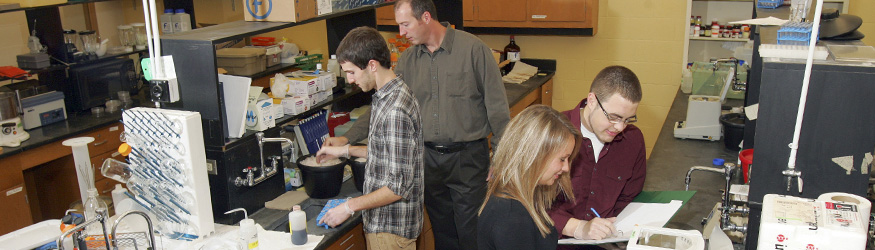
A diverse array of laboratory equipment that can be used for research and teaching in the plant sciences is available in the department. Many of the larger equipment items, including growth chambers, incubators, and centrifuges are located in common areas. Other equipment for molecular, biochemical, or physiological work is located in the individual investigator's laboratories, although it is generally available for use with permission from the head of the lab.