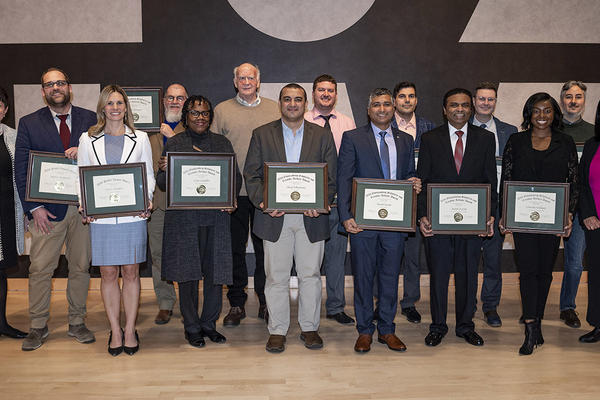
Wright State honors outstanding faculty at inaugural research awards event
Wright State faculty were honored with the Outstanding Scholarly and Creative Activities Awards and the Public Impact Recognition Awards.

Wright State’s Department of Physics has a track record you can count on! If you want to pursue a challenging but rewarding career, consider our four undergraduate bachelor’s degree programs and three graduate degree programs.
Our graduates are professors, scientists, and engineers employed at national laboratories and a variety of private companies. They also work outside of science and engineering as medical doctors and legal counsel for corporations.
Since 1965, more than 300 students have successfully completed their physics studies at Wright State. Many of our graduates are or have been employed with area companies such as the Air Force Research Laboratory, Berriehill Research Corporation, Cornerstone Research, Defense Research Associates, Mound Labs, Photon-X, Prime Control, SET Associates, Spectral Energetics, and Spectral Energies. These are just a few companies that hire Wright State physics graduates for both careers and internships/co-ops.
You can find work here in Dayton—but you can also complete your studies here. First, choose an undergraduate program. When you do, consider our 4+1 dual-degree option that allows you to complete your B.S. and M.S. in five years. Finish your preparation with a Ph.D. in interdisciplinary applied science and mathematics that will give you the education needed to apply for any position, anywhere, in this field!
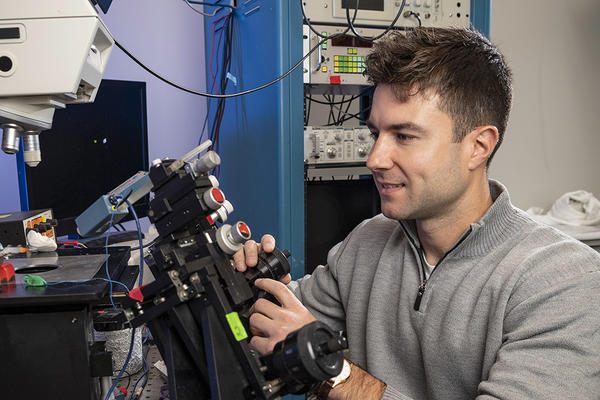
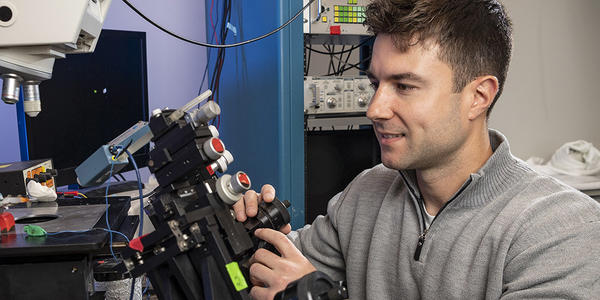 Former Raider and professional soccer player Christopher Dupont returned to Wright State to conduct research while pursuing M.D. and Ph.D. degrees. |
 After graduating with a bachelor’s degree in Physics from Wright State in April, Jacen Urbaniak will pursue a Ph.D. in physics at Worcester Polytechnic Institute. |