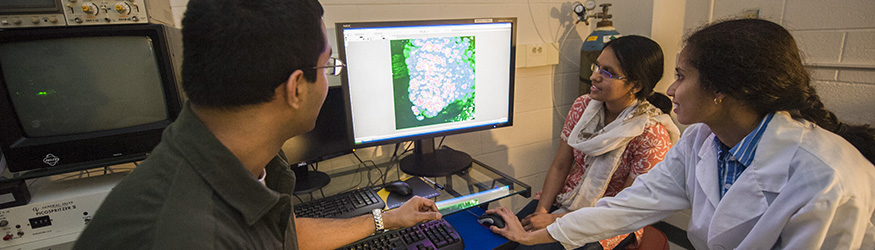
You will work with a group of faculty members recently recognized as the fourth-most productive in terms of research and professional activity among “small research universities” (less than 15 Ph.D. programs) nationally. Learn from experts in their fields—editors and reviewers for numerous journals and granting organizations and researchers developing the latest cutting-edge methodologies and instrumentation.
This fact isn’t just good for them; it’s also good for you! Our program is structured to give you one-on-one interaction with these experts. You will be trained to master sophisticated equipment, experimental methods, and current theory. You will personally contribute to grant proposals and author your own papers; you're not just a name at the bottom of a list.
You will work directly with the primary investigator, your mentor. You’ll be glad to know that this mentor is chosen, not by a panel or an advisor, but by you! If you already have a clear vision for your area of study when you enter the program, you are free to declare it from the beginning and choose your mentor immediately. But if you haven’t entirely settled on your area of focus, you can take up to a year to explore your interests before choosing your mentor. It’s up to you!
It is an integral part of our culture that faculty, staff, and other students maintain an “open door policy.” This means you have ready access to expertise, equipment, or advice, whether it’s inside or outside of your area of focus.
In healthy subjects, the excitable axonal domains known as the axon initial segment (AIS) and node of Ranvier (node) allow rapid, efficient, and regulated communication within the nervous system. Emerging evidence indicates that subtle disruption and/or plasticity of the structure-function relationship at these domains impairs neuronal function and is associated with a wide variety of neurological diseases.
Premier Health executive, Miami Valley Hospital chief medical officer and Wright State Boonshoft School of Medicine alum to give keynote address
High school and college students can explore health care programs and careers on President’s Day during Wright State’s annual Path to Health Professions Day.